
NPS Survey Questions: Examples and Follow-Up Prompts
NPS survey questions begin with one neutral recommendation prompt on a 0-to-10 scale. Use the examples below to choose a clear context, invite an optional reason, and collect feedback your team can interpret without turning a short survey into an interrogation.

NPS survey questions: the standard recommendation prompt
The standard Net Promoter Score question asks how likely a person is to recommend a company, product, or service to someone else. A familiar wording is: “On a scale from 0 to 10, how likely are you to recommend [Company] to a friend or colleague?” The respondent chooses one number, where 0 means not at all likely and 10 means extremely likely.
That single recommendation item is what makes the result an NPS measure. Ratings of 9 or 10 are promoters, 7 or 8 are passives, and 0 through 6 are detractors. The score is calculated from the share of promoters minus the share of detractors. The question should make the object of the recommendation clear before you collect answers.
| Survey context | Adaptable prompt | What the answer represents |
|---|---|---|
| Relationship | How likely are you to recommend [Company] to a friend or colleague? | Overall relationship with the organization |
| Product | How likely are you to recommend [Product] to someone with a similar need? | Experience with one named product |
| Support interaction | Based on your recent support experience, how likely are you to recommend [Company]? | One recent support journey |
| Purchase | After your purchase, how likely are you to recommend [Store] to a friend? | A defined transaction or purchase |
| Onboarding | Based on getting started with [Product], how likely are you to recommend it? | The setup and early-use experience |
Examples of NPS questions for different survey moments
An NPS question can refer to a company, product, store, or recent interaction. Choose one subject that matches the decision you want the result to inform. If a customer answers about a support case, the result describes that experience; it should not be presented as a whole-company relationship score without explanation.
Relationship surveys look at the wider customer relationship, while transactional surveys ask about a specific event such as delivery, onboarding, or support. Both can be useful, but they answer different questions. Give each a clear label in your reports and avoid merging their results into one trend as if the prompts and audiences were identical. Keep NPS survey questions consistent within each program; if the wording or audience changes, record the change before comparing periods.
Keep the scale and endpoints visible. Put the company or product name where the respondent can identify it, remove internal jargon, and test the wording with a few people who resemble the intended audience. A quick comprehension check can reveal whether “recommend” means the same thing to the team and to the people receiving the survey.
Check the comparison before changing wording
If you want to compare with an earlier survey, preserve its prompt or clearly mark where the design changed.
- Name one product or experience.
- Keep the 0-to-10 direction and endpoints clear.
NPS follow-up questions that add customer context
A rating shows the direction of a response; a short written answer can explain what the person had in mind. Make the follow-up optional and neutral so customers can raise an unexpected issue instead of choosing only from themes your team already expects. Choose one prompt that fits the workflow rather than showing every option at once.
- Do not treat a low score as proof that the customer wants a sales call; ask separately for permission to follow up.
- Avoid asking for names or sensitive details in a comment box when an aggregate theme is enough.
- Use the same core reason prompt across periods if you want to compare written themes.
| Rating group | Possible follow-up | What to listen for |
|---|---|---|
| Detractors, 0–6 | What is the main reason for the rating you gave? | A specific obstacle, unmet need, or service recovery issue |
| Passives, 7–8 | What is one change that would make you more likely to recommend us? | A concrete gap between an acceptable and a stronger experience |
| Promoters, 9–10 | What do you value most about your experience with us? | An experience or outcome worth protecting and repeating |
A short NPS survey sequence you can adapt
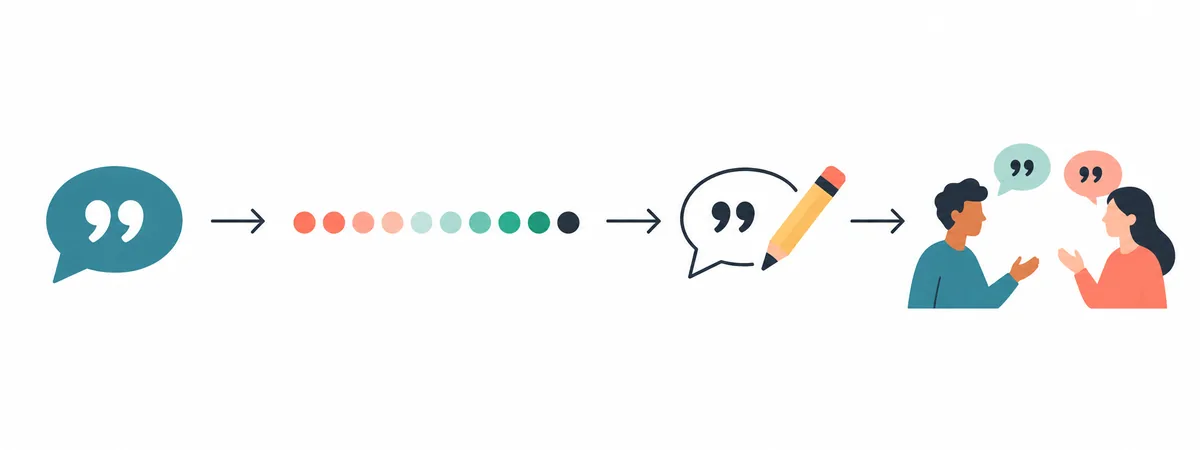
For many feedback checks, one rating question and one optional reason prompt are enough to start a useful conversation. Ask for the rating before asking why, so the explanation does not frame the score in advance. A short introduction should identify the experience, set a reasonable time expectation, and explain who can see an identifiable answer.
- Introduce the momentName the purchase, interaction, or relationship the respondent should think about.
- Ask the recommendation itemShow every number from 0 to 10 with clear low and high endpoint labels.
- Invite a reasonOffer one optional open-text prompt after the rating, with enough space for a short answer.
- Offer contact separatelyAsk whether the person wants a reply; do not infer consent from a low rating or a written comment.
Timing, channel, and access affect the answers
There is no single send time for every NPS survey. Send a transaction survey after the customer can fairly evaluate the event but while it is still clear; use a reasonable cadence for relationship surveys. NPS survey questions work best when people can recall the experience and judge it fairly. Match the channel to the audience, make all eleven options easy to activate on a phone, and record the trigger and field dates.
- Set a reasonable contact limit so one person is not repeatedly surveyed in a short period.
- Keep the scale labels, focus order, and tap targets clear for keyboard and mobile users.
- Record the invitation channel, audience rule, and trigger event beside each survey wave.
- Separate a service recovery contact from a general survey reminder when the customer needs support.
NPS question wording mistakes to avoid
A short survey can still distort an answer if it nudges the respondent. Avoid celebratory framing, claims about recent improvements, or positive benefits before the rating. Do not bundle the recommendation item with separate satisfaction measures for support, price, ease of use, or features; ask and label each measure accurately.
- Do not change the 0-to-10 scale to stars or a five-point scale and still describe the result as standard NPS.
- Do not make the follow-up leading, such as asking which feature made the customer recommend you before they have explained the score.
- Do not ask a respondent to rate several products in one question.
- Do not compare unrelated customer groups or survey moments without stating the differences.
- Do not publish a benchmark claim unless the source, population, field period, and question method are comparable.
Keep NPS survey results interpretable over time
Save the question, audience, channel, trigger, field dates, response count, and any form changes beside the score. Mark when the design changes, and review written reasons and response mix before comparing periods. Use the NPS calculator for aggregate counts or the score-meaning guide to interpret a completed result.
NPS survey questions FAQ
What is the standard NPS survey question?
It asks how likely a person is to recommend a named company, product, or service on a 0-to-10 scale. A common form is: “How likely are you to recommend [Company] to a friend or colleague?” Make the subject and both scale endpoints clear.
What is a good follow-up question for NPS?
A neutral option is “What is the main reason for your rating?” It invites context without assuming the answer. You can tailor an optional prompt to the rating group, but keep the wording respectful and give the respondent a way to skip it.
How many NPS survey questions should a survey include?
Start with the recommendation rating and, if useful, one optional open-ended reason. Add a separate contact-permission question only when someone will actually respond. Avoid collecting details that are already available elsewhere or that do not support a decision.
When should I send an NPS survey?
Choose a time that matches the experience in the question: recent enough for the details to be clear, but not before the person can fairly evaluate it. Use a consistent, reasonable cadence for relationship surveys and avoid repeatedly contacting the same person.
Source for the standard NPS measure
Bain’s measurement guide describes the recommendation question, 0-to-10 scale, and response groups used to calculate Net Promoter Score.
Make the question easy to answer and easy to interpret
Choose one customer experience, keep the rating scale clear, invite a reason without pressure, and save the survey design with the result. Then read the score alongside the customer’s words and the sample context.
Open the NPS calculator